Wednesday, August 4, 2010
Garfinkel
[Image]
Harold GarfinkelPROFESSOR EMERITUS at UCLAPh. D., Harvard UniversityClass WebsitesOffice: A83 HAINES Phone: 3108253328 Fax: 310-206-9838 E-mail: garfinkel@soc.ucla.edu Mailing Address:UCLA Department of Sociology 264 Haines Hall - Box 951551 Los Angeles, CA 90095-1551 SubfieldEthnomethodologyResearch InterestsClassic studies of social order and ethnomethodological studies agree that the animal they are hunting is the production and accountability of the phenomena or order, reason, logic, etc. in, about, and as the great recurrences of immortal ordinary society, really, actually, evidently, distinctively, and in detail. A selected corpus of ethnomethodological studies offers evidence for locally produced, naturally accountable phenomena of order, logic, reason, meaning, method, objective knowledge, evidence, detail, structure, etc., in and as of the unavoidable and irremediable haecceity of immortal ordinary society. These results are collected by and come to a head in ethnomethodological studies of discovering work in the natural sciences. The results are contrary to the classic policies, methods, claims, and findings of professional sociology and the world-wide social science movement.Selected Publications"The Work of a Discovering Science construed with Materials from the Optically Discovered Pulsar," (with Eric Livingston and Michael Lynch), Philosophy of the Social Sciences, 11(2):131-158, 1981. "Evidence for Locally Produced, Naturally Accountable Phenomena of Order*, Logic, Meaning, Method, etc., in and as of the Essentially Unavoidable and Irremediable Haeceeity of Immortal Ordinary Society: (I of IV) An Announcement of Studies," Sociological Theory '88, (6)1: 103-109, Spring 1988.
Harold Garfinkel (born 29 October 1917) is Professor Emeritus in sociology at the University of California, Los Angeles. Garfinkel took his PhD in 1952 from Harvard University, where he was supervised by Talcott Parsons. His thesis was titled "The Perception of the Other: A Study in Social Order"; it remains unpublished but highly influential, especially on the early years ofethnomethodology.EthnomethodologyGarfinkel is the originator of the ethnomethodological approach to sociology and, alongside Aaron Cicourel and Harvey Sacks, he is often cited as having been a major contributor to its development, articulation and spread. However, these three progenitors have each carved their own path. Until his death, Sacks focused on conversation analysis, a strand which has virtually cut loose from its ethnomethodological roots to become a free standing sociological method. Cicourel pioneered what he termed "Cognitive Sociology".Early ethnomethodological work was initially distributed via mimeographs. Garfinkel’s groundbreaking monograph "Studies in Ethnomethodology" was not formally published until 1967 and contains a series of essays concerning a number of distinct research projects. These essays pursue the ethnomethodological theme of the production of social order. His subsequent development of ethnomethodology has followed this pattern in that it is best seen as programmatic rather than theoretical. Garfinkel does not articulate a social theory as much as a sociological stance.Although his work is a radical rethinking of how to do sociology, he has acknowledged his intellectual debt to the more traditional figures of Émile Durkheim and Parsons, as well as to the phenomenological approach of Alfred Schütz.[1] Through his understanding of phenomenology, Garfinkel has sought to "respecify" traditional readings of Durkheim’s aphorism. Durkheim suggested that "[t]he objective reality of social facts is sociology’s fundamental principle." In an alternate formulation, he suggested that social facts should be understood as sociology’s fundamental phenomenon. Garfinkel prefers this reading and suggests a move toward a recognition that sociological facts are "locally endogenously produced, naturally organized, reflexively accountable, ongoing, practical achievement[s]."[1]Garfinkel emphasizes the indexicality of language and the difficulties this creates for the production of objective accounts of social phenomena. However, his notion of indexicality is much broader than the philosophical or linguistic concept. For Garfinkel, all talk is indexical to the context in which it takes place and/or refers. Garfinkel rejects the representational view of language, preferring the more Wittgensteinian or Austinian account of speech act theory. This means that language, speech acts and social accounts are reflexive to the settings in which they are produced: they depend upon that setting for their meaning and the setting’s meaning depends on reflexive articulation. In recognizing this, Garfinkel’s concept of the incarnate accountability of social action can be seen. All social situations are accountable by, and to, its participants in that participation in the situation itself is to produce and respond to context relevant information and cues.Ethnomethodological studies come in a wide variety of forms, including the sequential analysis of conversation; the study of social categorization practices (membership category analysis); studies of workplace settings and activities (studies of work).InfluenceGarfinkel has had a major influence on the Social Studies of Science and Science and Technology Studies. In particular, his ideas have influences initial "laboratory ethnographies" and the work of such major figures as David Bloor, Steve Woolgar, Bruno Latour and Karin Knorr-Cetina. A major recent ethnomethodology in the field isMichael Lynch's Scientific Practice and Ordinary Action: Ethnomethodology and Social Studies of Science.Psychiatrist R. D. Laing cited Garfinkel's "Conditions of Successful Degradation Ceremonies" in several of his books; he considered the psychiatric interview to be an example of a degradation ceremony. This meant, in Garfinkel's terms, that the psychiatrist officially denounces (labels) a patient as mentally ill, which reduces the patient to a lower level in the scheme of social types, i.e., "separated from [and opposed to] a place in the legitimate [social] order."An excerpt from "Studies in Ethnomethodology" was included in the 1973 anthology Rules and Meanings: The Anthropology of Everyday Knowledge, edited by Mary Douglasand published by Penguin Books.Selected WorksMoon, B., ed (1946). "Color Trouble". Primer for White Folks (New York: Doubleday Doran): 269–286.(1956). "Conditions of successful degradation ceremonies".American Journal of Sociology 61: 420–424.(1956). "Some sociological concepts and methods for psychiatrists". Psychiatric Research Reports 6: 181–198.Harvey, O.J., ed (1963). "A conception of, and experiments with, 'trust' as a condition of stable concerted actions".Motivation and Social Interaction (New York: Ronald Press): 187–238.(1967) "Studies in Ethnomethodology". (Englewood Cliffs, NJ: Prentice-Hall)Shneidman, E., ed (1967). "Practical sociological reasoning: Some features in the work of the Los Angeles suicide prevention center" Essays in Self-destruction (New York: Science House): 171–186.Hill, R.; Grittenden, K., eds (1968). "Discussion: The origin of the term 'ethnomethodology'". Proceedings of the Purdue Symposium on Ethnomethodology(Institute Monograph Series #1): 15–18.With Sacks, Harvey (1970); McKinney, J.; Tiryakian, E., eds. "On formal structures of practical actions". Theoretical Sociology: Perspectives and Developments (New York: Meredith): 337–366.(1972). "A Comparison of Decisions Made on Four 'Pre-Theoretical' Problems by Talcott Parsons and Alfred Schultz" (first published in 1960).Sudnow, D., ed (1972). "Studies in the routine grounds of everyday activities". Studies in Social Interaction (New York: Free Press): 1–30 (first published in 1964).Manis, J; Meltzer, B., eds (1972). "Conditions of Successful Degradation Ceremonies"Symbolic Interactionism (New York: Allyn & Bacon): 201–208.(1976). "An introduction, for novices, to the work of studying naturally organized ordinary activities".(1981). "The Work of a Discovering Science Construed with Materials from the Optically Discovered Pulsar". Philosophy of the Social Sciences 11: 131–158.(Spring 1988). "Evidence for Locally Produced, Naturally Accountable Phenomena of Order, Logic, Meaning, Method, etc., in and as of the Essentially Unavoidable and Irremediable Haeceeity of Immortal Ordinary Society: (I of IV) An Announcement of Studies" (also known as "Parson's Plenum").Sociological Theory '88 (6) 1: 103–109.(2002). "Ethnomethodology's program: Working out Durkheim's aphorism" (Lanham, MD: Rowman & Littlefield).(November 2005). "Seeing Sociologically: The Routine Grounds of Social Action".(December 2008). "Toward a Sociological Theory of Information".(August 2010). Studies in Ethnomethodology: Expanded and Updated Edition.[edit]ReferencesHarold Garfinkel at UCLAPhotos of Harold Garfinkel at the conference "Orders of Ordinary Action" in Manchester, UK in 2001.


Mary Douglas (from Wikipedia)
.jpg) Dame Mary Douglas, DBE, FBA(25 March 1921 – 16 May 2007) was a British anthropologist, known for her writings on human cultureand symbolism.
Dame Mary Douglas, DBE, FBA(25 March 1921 – 16 May 2007) was a British anthropologist, known for her writings on human cultureand symbolism.Her area was social anthropology; she was considered a follower ofÉmile Durkheim and a proponent of structuralist analysis, with a strong interest in comparative religion.
Biography
She was born as Margaret Mary Tew in San Remo, Italy to Gilbert and Phyllis (née Twomey) Tew. Her father was in the British colonial service. Her mother was a devout Roman Catholic, and Mary and her younger sister, Patricia, were raised in that faith. After their mother's death, the sisters were raised by their maternal grandparents and attended the Roman Catholic Sacred Heart Convent in Roehampton (laterWoldingham School). Mary went on to study at St Anne's College, Oxford from 1939 to 1943; there she was influenced by E. E. Evans-Pritchard.
She worked in the British Colonial Office until 1947, when she returned to Oxford to take up graduate study she had left. She studied with M. N. Srinivas as well as Edward Evans-Pritchard. In 1949, she did field workwith the Lele people in what was then the Belgian Congo; this took her to village life in the region between the Kasai River and the Loange River, where the Lele lived on the edge of the previous Kuba Kingdom.
In the early 1950s, she completed her doctorate, married James Douglas. Like her, he was a Catholic and had been born into a colonial family (in Simla, while his father served in the Indian army). They would have three children. She taught at University College, London, where she remained for around 25 years, becoming Professor of Social Anthropology.
Her reputation was established by her book Purity and Danger (1966). She wrote The World of Goods(1978) with an econometrician, Baron Isherwood, which was considered a pioneering work on economic anthropology. She published on such subjects as risk analysis and the environment, consumption and welfare economics, and food and ritual, all increasingly cited outside anthropology circles.
She taught and wrote in the USA for 11 years. After four years (1977–81) as Foundation Research Professor of Cultural Studies at the Russell Sage Foundation in New York, she moved to Northwestern University as Avalon Professor of the Humanities with a remit to link the studies of theology and anthropology, and spent three years at Princeton University. In 1988, she returned to Britain, where she gave the Gifford Lectures in 1989.
In 1989, she was elected a Fellow of the British Academy. She became a Commander of the Order of the British Empire (CBE) in 1992, and was appointed Dame Commander of the Order of the British Empire (DBE) in the Queen's New Year's Honours List published on 30 December 2006. She died on 16 May 2007 in London, aged 86, from complications of cancer, survived by her three children. Her husband died in 2004.
Contributions to anthropology
Mary Douglas is best known for her interpretation of the book of Leviticus, and for her role in creating the cultural theory of risk.
Douglas' book Purity and Danger is considered a key text in social anthropology.
The line of enquiry in Purity and Dangertraces the words and meaning of dirt in different contexts. What is regarded as dirt in a given society is any matter considered out of place (Douglas takes this lead from William James). She attempts to clarify the differences between the sacred, the clean and the unclean in different societies and times. Through a complex and sophisticated reading of ritual, religion and lifestyle she challenges Western ideas of pollution, making clear how the context and social history is essential.
In Purity and Danger, Douglas first proposed that the kosher laws were not, as many believed, either primitive health regulations or randomly chosen as tests of Jews' commitment to God. Instead, Douglas argued that the laws were about symbolic boundary-maintenance. Prohibited foods were those that did not seem to fall neatly into any category. For example, pigs' place in the natural order was ambiguous because they shared the cloven hoof of the ungulates, but did not chew cud.
Later in a 2002 preface to Purity and Danger, Douglas went on to retract her initial explanation of the kosher rules, saying that it had been "a major mistake." Instead, she proposed that "the dietary laws intricately model the body and the altar upon one another" as of land animals, Israelites were only allowed to eat animals that were also allowed to be sacrificed: animals that depend on herdsmen. Thus, Douglas concludes that animals that are abominable to eat are not in fact impure, as the "rational, just, compassionate God of the Bible would [never] have been so inconsistent as to make abominable creatures." Douglas makes it clear in Purity and Danger that she does not endeavour to judge religions as pessimistic or optimistic in their understanding of purity or dirt as positive (dirt affirming) or otherwise.
In Natural Symbols (first published 1970), Douglas introduced the interrelated concepts of "group" (how clearly defined an individual's social position is as inside or outside a bounded social group) and "grid" (how clearly defined an individual's social role is within networks of social privileges, claims and obligations). The group-grid pattern was to be refined and redeployed in laying the foundations of cultural theory.
Works
- The Lele of the Kasai (1963)
- Purity and Danger: An Analysis of Concepts of Pollution and Taboo(1966)
- Pollution (1968)
- Natural Symbols: Explorations in Cosmology (1970)
- Rules and Meanings. The Anthropology of Everyday Knowledge: Selected Readings, edited by Mary Douglas (Penguin Books, 1973).
- Implicit Meanings: Essays in Anthropology (1975)
- Jokes, in Rethinking Popular Culture: Contemporary Perspectives in Cultural Studies (1975); edited by Chandra Mukerji and Michael Schudson
- The World of Goods (1979) with Baron Isherwood
- Evans-Pritchard (1980)
- Risk and Culture (1980) with Aaron Wildavsky
- In the Active Voice (1982)
- How Institutions Think (1986)
- Missing persons: a critique of the social sciences (1988) with Steven Ney
- Risk and Blame: Essays in Cultural Theory (London: Routledge, 1992).
- In the Wilderness: The Doctrine of Defilement in the Book of Numbers (1993)
- Thought styles: Critical essays on good taste (1996)
- Leviticus as Literature (1999)
- Constructive Drinking: Perspectives on Drink from Anthropology(2002)
- Jacob's Tears: The Priestly Work of Reconciliation (2004)
- Thinking in Circles (2007)
External links
- Mary Douglas Papers, 1948–1985, Northwestern University Archives, Evanston, Illinois
- Sketch from Univ of Pennsylvania as Honorary degree recipient in 2000
- Mary Douglas at the National Portrait Gallery.
- Bibliography
- Obituary in The Guardian
- Obituary in The Times
- Obituary in The Daily Telegraph, 22 May 2007.
- New York Times obituary available in Cache version
- The Star Obituary
- Commonweal Anthropology with a Difference
- Mary Douglas interviewed by Alan Macfarlane, 26 February 2006 (film).
- A web site exploring the continuing legacy of Mary Douglas, especially with reference to her Grid-Group typology.
Monday, May 4, 2009
It can come across as offensive.
Ok what does that mean? What specifically will it do to your identity and your relationship with those offended? How would it alter the way those people interact with you? Would they relegate you to the status of tolerated acquaintance? Would it make them reluctant to introduce you to their significant other or their family or their boss?
Kyle, Susan, Allie, Whitney S. : China and Proxemics
Really nice work on this discovery: women's interaction with women and women's interaction with men are most similar in American culture, and men's interaction with men is the most different, whereas in Chinese culture women's and women's and men's and men's are the most similar, where mixed interactions are the most different.
Friday, April 10, 2009
Friday, April 3, 2009
Calendar for Week11: 4/6, 4/8, holiday on 4/10
Apply your diagnostic with your informant and other subjects outside of class
Read:
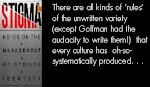
Stigma 66-104
Friday: NO CLASS (:
Read:
Stigma 66-104
Friday: NO CLASS (:
Friday, March 27, 2009
Calendar for Week 10: 3/30, 4/1, 4/3
Due Monday: Report to class what you're doing for your diagnostic and submit to ee
Read:
1) Polite Fictions 41-59
2) Stigma 41-66
Read:
1) Polite Fictions 41-59
2) Stigma 41-66
Monday, March 16, 2009
Calendar for Week 9: 3/23, 3/25/3/27
Focus on designing your own diagnostic
What aspects of each reading so far will you incorporate in your diagnostic?
Read:
Stigma 1-40
What aspects of each reading so far will you incorporate in your diagnostic?
Read:
Stigma 1-40
Friday, March 13, 2009
Friday, March 6, 2009
Calendar for Week 8: 3/9, 3/11, 3/13
Due Monday: Ist Informant Presentations 5-7 minutes
Read:
Polite Fictions 62-79
Wednesday: MIDTERM EXAM
Friday: Midterm returned
Read:
Polite Fictions 62-79
Wednesday: MIDTERM EXAM
Friday: Midterm returned
Saturday, February 28, 2009
Peru Group: Tiana, BJ, Whitney C.
1. Turn taking-Do you ever feel like you cannot keep up in a conversation in America?
2. Do Americans tend to interrupt you?
3. What kinds of visual signs/signals do you used to inform individuals and groups of when to start/stop talking or change the subject or anything else?
4. How is turn regulated/How do you know when to talk?
5. Who is allowed to talk to who in order to be socially acceptable?
6. Are there stipulations as to how do address someone or greet someone?
7. When someone talks at the same time as you, is one person assumed to step down?
8. How is this addressed by the rest of the group and how do they perceive it?
2. Do Americans tend to interrupt you?
3. What kinds of visual signs/signals do you used to inform individuals and groups of when to start/stop talking or change the subject or anything else?
4. How is turn regulated/How do you know when to talk?
5. Who is allowed to talk to who in order to be socially acceptable?
6. Are there stipulations as to how do address someone or greet someone?
7. When someone talks at the same time as you, is one person assumed to step down?
8. How is this addressed by the rest of the group and how do they perceive it?
China Group: Martyn, Kimberly, Michael, Melora
1. When listening to someone else speaking, how do you affirm that you are listening to what they are saying?
2. How big of a gap do you leave between speakers before you resume or begin talking?
3. Does your culture have any specific affixes/prefixes or titles (such as for family members) when addressing them? If so, when do you use them and where?
4. Who is it most proper to address first in a group of people (is it based on age, status, family, or whom you are most comfortable with)?
5. When answering a question, do you repeat the question when answering or rephrase the question in your answer?
6. Do you ever ask a question that is really a demand (imperative)?
7. Do you ever switch between polite/formal speech to informal speech in the same conversation?
8. How long does a relationship with someone have to be before you speak informally with them?
9. As you grow older, do you convey more politeness r take on more informal speech when speaking to your parents?
10. How do you respond to someone insulting themselves?
11. What do you say when you enter someone’s home as a guest?
2. How big of a gap do you leave between speakers before you resume or begin talking?
3. Does your culture have any specific affixes/prefixes or titles (such as for family members) when addressing them? If so, when do you use them and where?
4. Who is it most proper to address first in a group of people (is it based on age, status, family, or whom you are most comfortable with)?
5. When answering a question, do you repeat the question when answering or rephrase the question in your answer?
6. Do you ever ask a question that is really a demand (imperative)?
7. Do you ever switch between polite/formal speech to informal speech in the same conversation?
8. How long does a relationship with someone have to be before you speak informally with them?
9. As you grow older, do you convey more politeness r take on more informal speech when speaking to your parents?
10. How do you respond to someone insulting themselves?
11. What do you say when you enter someone’s home as a guest?
Saudia Arabia Group: Sarah P. , Megan S.
1. After inviting someone over, is it polite to serve them or appropriate to allow them to serve themselves?
2. When in the company of guests is it appropriate to be relaxes in manner or have more self-control and remain formal? If neither, what is appropriate?
3. In TV programs, if something is going wrong for the good guys, how would they react?
4. In a work scenario, is it appropriate to joke around? How would people react if people were joking?
5. In a high stress situation, like turbulence on a plane, how would people in your culture respond to humor?
6. How is dependency on others viewed in Saudi Arabia? In times of necessary dependence how is gender and age figured in?
7. When asking for a favor, in what manner of speaking should the request be presented—apologetic, act inferior, just use please/colloquial language? What if you are asking for something from someone you do not know (ie a University scholarship committee)?
8. When explaining things about yourself for applications is it more appropriate to give straight facts or to embellish your accomplishments? If neither, what is appropriate?
9. If something like an animal has a disability, in what way would it be viewed—would someone in your culture take it upon themselves to care for it or would just feel pity and move on?
10. If a friend lost a job and you wanted to comfort them, what would you say? Would you even want to comfort them? Does it depend on age or gender?
11. What would be the most appropriate way to approach someone who is grieving a loss?
12. If you are unable to complete a request for a friend, how does someone in your culture best deny this request?
13. If someone you know is about to take a test (admissions test for college or the like,if you wrote them a card what you it say? What would a parent’s card to a child say in this situation?
2. When in the company of guests is it appropriate to be relaxes in manner or have more self-control and remain formal? If neither, what is appropriate?
3. In TV programs, if something is going wrong for the good guys, how would they react?
4. In a work scenario, is it appropriate to joke around? How would people react if people were joking?
5. In a high stress situation, like turbulence on a plane, how would people in your culture respond to humor?
6. How is dependency on others viewed in Saudi Arabia? In times of necessary dependence how is gender and age figured in?
7. When asking for a favor, in what manner of speaking should the request be presented—apologetic, act inferior, just use please/colloquial language? What if you are asking for something from someone you do not know (ie a University scholarship committee)?
8. When explaining things about yourself for applications is it more appropriate to give straight facts or to embellish your accomplishments? If neither, what is appropriate?
9. If something like an animal has a disability, in what way would it be viewed—would someone in your culture take it upon themselves to care for it or would just feel pity and move on?
10. If a friend lost a job and you wanted to comfort them, what would you say? Would you even want to comfort them? Does it depend on age or gender?
11. What would be the most appropriate way to approach someone who is grieving a loss?
12. If you are unable to complete a request for a friend, how does someone in your culture best deny this request?
13. If someone you know is about to take a test (admissions test for college or the like,if you wrote them a card what you it say? What would a parent’s card to a child say in this situation?
China Group: Allie, Kyle, Susan, Whitney S.
1) Is it appropriate to discuss politics and religion with someone you just met?
2) Is it appropriate to oppose or condemn someone's religious preference?
3) Is it appropriate to talk about success in the workplace and monetary success with someone you just met?
4) What is the appropriate response to a greeting? If someone asks "how are you?" or its equivalent in the Chinese culture, is it appropriate to give a detailed response?
5) Is it considered rude to interrupt someone while they are speaking, or does interruption reflect eager involvement in the conversation?
6) What should be stated directly in conversation? What things should be stated indirectly? Does directness imply imposition?
7) Is it appropriate to accept something the first time it is offered to you?
8) Does a rising or falling intonation in speech reflect a question? How are questions stated?
9) How much information should be provided in order to create a sufficient context for your conversation? How much background is necessary?
10) What is a comfortable level of personal space in conversation? Is this dependent on the relationship between speaker and listener?
11) Is verbal aggressiveness considered threatening, confrontational, engaging, or something entirely different? Is the use of verbal aggressiveness depend on your listener?
12) What assumptions / expectations are associated with conversational overlap? Is overlap associated with imposition or involvement? Is this, too, contingent on the relationship between speaker and listener?
13) How do gender differences affect conversation? Does it affect personal space? Does it affect directness/indirectness? Does age play a factor? Does it affect word choice and intonation?
14) What is the appropriate amount of pause between turns?
15) Is it more appropriate to be aggressive or submissive in your culture? Is this contingent upon the audience?
16) Is it more acceptable to speak more quickly or more slowly in your culture? How is speed of speech perceived?
17) What does insistence and repitition imply in your culture? Is it considered rude and imposing? Does it emphasize what you are trying to say? Is it contingent on the situation?
18) After being asked a question, is it polite or rude to respond with a question? Does responding with a question reflect selflessness and produce a sense that the other person is valued more than yourself? Or does it reflect avoidance and apathy?
2) Is it appropriate to oppose or condemn someone's religious preference?
3) Is it appropriate to talk about success in the workplace and monetary success with someone you just met?
4) What is the appropriate response to a greeting? If someone asks "how are you?" or its equivalent in the Chinese culture, is it appropriate to give a detailed response?
5) Is it considered rude to interrupt someone while they are speaking, or does interruption reflect eager involvement in the conversation?
6) What should be stated directly in conversation? What things should be stated indirectly? Does directness imply imposition?
7) Is it appropriate to accept something the first time it is offered to you?
8) Does a rising or falling intonation in speech reflect a question? How are questions stated?
9) How much information should be provided in order to create a sufficient context for your conversation? How much background is necessary?
10) What is a comfortable level of personal space in conversation? Is this dependent on the relationship between speaker and listener?
11) Is verbal aggressiveness considered threatening, confrontational, engaging, or something entirely different? Is the use of verbal aggressiveness depend on your listener?
12) What assumptions / expectations are associated with conversational overlap? Is overlap associated with imposition or involvement? Is this, too, contingent on the relationship between speaker and listener?
13) How do gender differences affect conversation? Does it affect personal space? Does it affect directness/indirectness? Does age play a factor? Does it affect word choice and intonation?
14) What is the appropriate amount of pause between turns?
15) Is it more appropriate to be aggressive or submissive in your culture? Is this contingent upon the audience?
16) Is it more acceptable to speak more quickly or more slowly in your culture? How is speed of speech perceived?
17) What does insistence and repitition imply in your culture? Is it considered rude and imposing? Does it emphasize what you are trying to say? Is it contingent on the situation?
18) After being asked a question, is it polite or rude to respond with a question? Does responding with a question reflect selflessness and produce a sense that the other person is valued more than yourself? Or does it reflect avoidance and apathy?
India Group: Tessia, Emily, Courtney Ginger
1) In Indian culture, is it better to be self-deprecating in conversation, or self-promoting?
2) Is it polite to behave in ways that emphasize the status of a superior, or should you act like equals?
3) Are there different terms of address for older/younger men or women, and can you express more politeness by flouting or adhering to the appropriate term? (aka ma'am and miss) - value of age?
4) Is it more polite to admire certain qualities of people and not others, such as looks vs accomplishments vs possessions vs disposition?
5) Can you achieve the ends of politeness in convo. through ironic/sarcastic speech (specifically, saying something neg. about someone while pragmatic elements indicate the opposite or vice versa if talking about self), or is it better to keep meaning on surface level?
6) How important is it that you use the correct term of address to acknowledge someone's status?
2) Is it polite to behave in ways that emphasize the status of a superior, or should you act like equals?
3) Are there different terms of address for older/younger men or women, and can you express more politeness by flouting or adhering to the appropriate term? (aka ma'am and miss) - value of age?
4) Is it more polite to admire certain qualities of people and not others, such as looks vs accomplishments vs possessions vs disposition?
5) Can you achieve the ends of politeness in convo. through ironic/sarcastic speech (specifically, saying something neg. about someone while pragmatic elements indicate the opposite or vice versa if talking about self), or is it better to keep meaning on surface level?
6) How important is it that you use the correct term of address to acknowledge someone's status?
Angola: Sarah C, Lauren, Abby, Daniel C.
1) How did you interpret your first interactions with people when you moved here?
2) Has your view of Americans changed since you first moved here?
3) What types of rules govern your conversations with others?
4) Is it important to be very polite in order to respect others when you are talking to them?
5) Do you find Americans to be too personal with their conversations with you? Or not enough?
6) What do you consider the norm for personal space?
7) What defines politeness in your culture?
8) What is invading your personal space? w/ friends? strangers?
9) When you first meet someone, how do you feel about them in terms of respect?
10) What's your expectations of others in respecting you?
11) When you are with someone from a different culture, are you comfortable or do you feel intimidated?
12) Is it polite to use facial expressions - what do they mean?
13) What tones do you use w/ a friend vs. a stranger?
14) What tones do you use w/ an elder vs. a child?
15) How do you address people's names - do you give first/last name or just first?
16) How do you introduce yourself - first/last or just first?
17) Is it respectful to use Mr. and Mrs. when talking to someone?
18) Does social status determine your interactions?
19) Is social status the same in Angola as it is in the US?
20) In a convo, is building a relationship more important vs. distinguishing yourself?
2) Has your view of Americans changed since you first moved here?
3) What types of rules govern your conversations with others?
4) Is it important to be very polite in order to respect others when you are talking to them?
5) Do you find Americans to be too personal with their conversations with you? Or not enough?
6) What do you consider the norm for personal space?
7) What defines politeness in your culture?
8) What is invading your personal space? w/ friends? strangers?
9) When you first meet someone, how do you feel about them in terms of respect?
10) What's your expectations of others in respecting you?
11) When you are with someone from a different culture, are you comfortable or do you feel intimidated?
12) Is it polite to use facial expressions - what do they mean?
13) What tones do you use w/ a friend vs. a stranger?
14) What tones do you use w/ an elder vs. a child?
15) How do you address people's names - do you give first/last name or just first?
16) How do you introduce yourself - first/last or just first?
17) Is it respectful to use Mr. and Mrs. when talking to someone?
18) Does social status determine your interactions?
19) Is social status the same in Angola as it is in the US?
20) In a convo, is building a relationship more important vs. distinguishing yourself?
Tunisia Group: Sarah W, Anthony, Katie, Madeline
1) In a conversation is there a lot of overlap? Is it acceptable?
2) Does one person keep the "floor" longer because of his/her status?
3) Is it appropriate for two or more people to talk at the same time?
4) If it is not, is it considered interrupting?
5) Is there a difference in how often or how much you get to talk based on who you're speaking to? Man? Woman? Husband? Wife? Best friend? Employee? Boss, etc?
6) What is the appropriate way to talk, faster or slower?
7) Is the language you speak a faster language?
8) What is an appropriate amount of time to pause before someone else starts speaking? vs. English?
9) Are there different situations where the pace of a conversation is faster or slower?
10) Are there certain people that you talk to that affect the pace of a conversation? i.e. your boss, your husband (if you're a woman)?
11) Was it hard to adapt to America's conversation style as opposed to your own?
12) How about in Minnesota vs. Texas?
13) Is there a difference in pace, content, dialect, etc in different regions of your country? i.e. North, south, east...
14) Are conversations limited on how many questions you can ask per turn?
15) Is it common to switch between people in a conversation often? i.e. quick, quick, quick?
2) Does one person keep the "floor" longer because of his/her status?
3) Is it appropriate for two or more people to talk at the same time?
4) If it is not, is it considered interrupting?
5) Is there a difference in how often or how much you get to talk based on who you're speaking to? Man? Woman? Husband? Wife? Best friend? Employee? Boss, etc?
6) What is the appropriate way to talk, faster or slower?
7) Is the language you speak a faster language?
8) What is an appropriate amount of time to pause before someone else starts speaking? vs. English?
9) Are there different situations where the pace of a conversation is faster or slower?
10) Are there certain people that you talk to that affect the pace of a conversation? i.e. your boss, your husband (if you're a woman)?
11) Was it hard to adapt to America's conversation style as opposed to your own?
12) How about in Minnesota vs. Texas?
13) Is there a difference in pace, content, dialect, etc in different regions of your country? i.e. North, south, east...
14) Are conversations limited on how many questions you can ask per turn?
15) Is it common to switch between people in a conversation often? i.e. quick, quick, quick?
India Group: Janna, Alexa, Taylor, Stephen
Assigned reading: The Technical Editor as Diplomat
(some of our questions aren't directly related to the article but came from tangents we went off on from more related questions or from certain things mentioned in the article...fyi)
1) Is there a polite or preferred method of correcting someone in your native language, in writing or conversation? How do you do it?
2) To whom is your speech or writing most direct? Can you give examples of directness of speech/writing in different relationships, situations, contexts...?
3) Have you ever felt threatened when being corrected in conversation in your native language? Who was correcting you, and why?
4) Do you feel threatened when your use of English is corrected? When and by whom? About what?
5) Do you ever feel the need to be defensive or hostile to get your point across in either language? Is it different when you are writing than when you are speaking?
6) In your native language, are there different methods of framing a request or suggestion? Is it dependent upon who you are directing this toward? Who it's coming from?
7) Is it polite in your culture to reject advice or suggestions, or to tell someone you don't want advice? Should one tell the advice-giver that they will not use the advice given? Should one act appreciative of advice or suggestions, or treat them with little acknowledgement, whether or not it is used?
English? Can you give examples of different times you have felt the need to be more direct or more indirect in your use of both languages?
9) Does difference in emphasis of words change the meaning of your statement or question in your native language? How does it compare to the use of emphasis in English? Have you struggled with the differences?
10) Is there a 'passive voice' in your native language and how/when/with whom would you use it? Is it usually considered polite or impolite to speak in this way? Have you encountered differences with this in English, and if so, what problems has it caused, if any?
11) In your native language, when are interrogatives used, with whom, and in what situations? Are there any times you've used interrogatives to imply suggestion? How is this interpreted by the person you are communicating with, and what kinds of responses are usual?
12) Are there words in your native language that have the same or similar concept as an English word, and if so, in what ways is their use different than their English counterparts? Does it change the way you use the English word?
(Ex: Does the word for 'love' in your language get used as broadly as in English, as in saying "I love you" to your spouse versus saying "I love pizza.")
13) How does your culture view the use of borrowed English words, if there are any? What are some examples of English words that have been incorporated into your native language? (i.e., new technologies, medical terms, foods?)
14) Is it more acceptable in your native language to use direct suggestion versus hinting at what you are suggesting? Can you give examples of contexts where one may be more appropriate than the other?
15) Is advice generally accepted in your culture, or is it seen as invasive? What types of advice? Is advice more acceptable coming from certain people than from others?
16) What types of questions are viewed as personal, and what types are seen as impersonal? Is there a difference in politeness between them? How does your relationship or comparative status with the person asking the question affect how it is accepted or answered?
17) Have you ever been offended or have you offended somebody when asking or being asked questions in English? In your native language, by a non-native speaker? What were these questions and what were the responses?
18) How do different authority figures interact with children in regards to giving instruction? Do different people (teachers, parents, siblings, etc.) have different methods? Is suggestive guidance more common or is there more of an authoritative or demanding attitude toward teaching/raising children? How does this vary in different contexts?
19) How is punishment used and viewed in your culture? Who punishes who and for what? Is punishment treated more as a way to learn from ones mistakes, or is it seen as a method of revenge/retribution? How is this different from American views of punishment that you have encountered?
20) Is advice seeking common in your culture? How does one ask for advice? Is it asked for directly or is it implied that advice or suggestions are needed? To whom do people usually look for advice, and what types of advice are commonly sought after?
21) In a business setting, is it acceptable to make suggestions, give advice to, or correct your coworkers? Your boss, or other 'higher-ups'?
22) Is advice given publicly or in private? Is it seen as an embarassment to receive advice in front of others?
(some of our questions aren't directly related to the article but came from tangents we went off on from more related questions or from certain things mentioned in the article...fyi)
1) Is there a polite or preferred method of correcting someone in your native language, in writing or conversation? How do you do it?
2) To whom is your speech or writing most direct? Can you give examples of directness of speech/writing in different relationships, situations, contexts...?
3) Have you ever felt threatened when being corrected in conversation in your native language? Who was correcting you, and why?
4) Do you feel threatened when your use of English is corrected? When and by whom? About what?
5) Do you ever feel the need to be defensive or hostile to get your point across in either language? Is it different when you are writing than when you are speaking?
6) In your native language, are there different methods of framing a request or suggestion? Is it dependent upon who you are directing this toward? Who it's coming from?
7) Is it polite in your culture to reject advice or suggestions, or to tell someone you don't want advice? Should one tell the advice-giver that they will not use the advice given? Should one act appreciative of advice or suggestions, or treat them with little acknowledgement, whether or not it is used?
English? Can you give examples of different times you have felt the need to be more direct or more indirect in your use of both languages?
9) Does difference in emphasis of words change the meaning of your statement or question in your native language? How does it compare to the use of emphasis in English? Have you struggled with the differences?
10) Is there a 'passive voice' in your native language and how/when/with whom would you use it? Is it usually considered polite or impolite to speak in this way? Have you encountered differences with this in English, and if so, what problems has it caused, if any?
11) In your native language, when are interrogatives used, with whom, and in what situations? Are there any times you've used interrogatives to imply suggestion? How is this interpreted by the person you are communicating with, and what kinds of responses are usual?
12) Are there words in your native language that have the same or similar concept as an English word, and if so, in what ways is their use different than their English counterparts? Does it change the way you use the English word?
(Ex: Does the word for 'love' in your language get used as broadly as in English, as in saying "I love you" to your spouse versus saying "I love pizza.")
13) How does your culture view the use of borrowed English words, if there are any? What are some examples of English words that have been incorporated into your native language? (i.e., new technologies, medical terms, foods?)
14) Is it more acceptable in your native language to use direct suggestion versus hinting at what you are suggesting? Can you give examples of contexts where one may be more appropriate than the other?
15) Is advice generally accepted in your culture, or is it seen as invasive? What types of advice? Is advice more acceptable coming from certain people than from others?
16) What types of questions are viewed as personal, and what types are seen as impersonal? Is there a difference in politeness between them? How does your relationship or comparative status with the person asking the question affect how it is accepted or answered?
17) Have you ever been offended or have you offended somebody when asking or being asked questions in English? In your native language, by a non-native speaker? What were these questions and what were the responses?
18) How do different authority figures interact with children in regards to giving instruction? Do different people (teachers, parents, siblings, etc.) have different methods? Is suggestive guidance more common or is there more of an authoritative or demanding attitude toward teaching/raising children? How does this vary in different contexts?
19) How is punishment used and viewed in your culture? Who punishes who and for what? Is punishment treated more as a way to learn from ones mistakes, or is it seen as a method of revenge/retribution? How is this different from American views of punishment that you have encountered?
20) Is advice seeking common in your culture? How does one ask for advice? Is it asked for directly or is it implied that advice or suggestions are needed? To whom do people usually look for advice, and what types of advice are commonly sought after?
21) In a business setting, is it acceptable to make suggestions, give advice to, or correct your coworkers? Your boss, or other 'higher-ups'?
22) Is advice given publicly or in private? Is it seen as an embarassment to receive advice in front of others?
German Group: Katie Y., Vicky and Daniel P
1) Is there a certain age at which you assume the identity of your spouse?
2) To whom is it appropriate to give advice? Could you advise someone older? Younger? Of the opposite sex?
3) What is the appropriate way to decline an offer for dinner/a movie/hanging out? Do you accept and then just not show up, or do you decline from the start?
4) From whom is it appropriate to accept/decline a meal offer? Would you accept an offer to hang out from your boss?
5) How much alone time is socially acceptable?
6) Would it be acceptable to eat alone, see a movie alone? Could you sit alone in a café and read for pleasure? What about studying?
7) Do you refer to yourself in a group mindset, i.e. “We Germans”?
8) How much of “yourself” is acceptable to show in a social situation? Are there things you can and can’t do? (i.e. humming to yourself, talking to yourself, etc…)
9) When Germans watch TV or movies, do you watch for content of form? Are you viewing the actions of the characters and how they handle themselves or for what they actually do?
10)When dancing, do you dance however you want to dance, or are there set steps you do with a group?
11)When asked a question, is it acceptable to say “I don’t know” or must you have an opinion about the subject? With the lack of interaction Germans exhibit, would they even ask? Who would ask?
12)How do you go about disagreeing with someone’s opinion? Would you say something if you disagreed with your boss? Your grandma? Your spouse?
13)Would you ask someone why they felt the way they do about a subject? Would it depend on the people you’re talking with? What about the subject matter (i.e. touchy subjects)?
14)If your boss asks you a question about your political affiliations, would you respond truthfully? What if your spouse asked? How descriptive would you be? How much passion on the subject is acceptable?
15)If you know someone is embarrassed in a conversation, how do you go about saving their face? Would you redeem them or just ignore it?
16)When someone does decline an invitation, how much detail is usually given? Is it acceptable to probe into why the offer was declined?
17)What is the acceptable level of personal questions allowed? How far can a person delve into someone else’s psyche and ask what they think, feel and do?
2) To whom is it appropriate to give advice? Could you advise someone older? Younger? Of the opposite sex?
3) What is the appropriate way to decline an offer for dinner/a movie/hanging out? Do you accept and then just not show up, or do you decline from the start?
4) From whom is it appropriate to accept/decline a meal offer? Would you accept an offer to hang out from your boss?
5) How much alone time is socially acceptable?
6) Would it be acceptable to eat alone, see a movie alone? Could you sit alone in a café and read for pleasure? What about studying?
7) Do you refer to yourself in a group mindset, i.e. “We Germans”?
8) How much of “yourself” is acceptable to show in a social situation? Are there things you can and can’t do? (i.e. humming to yourself, talking to yourself, etc…)
9) When Germans watch TV or movies, do you watch for content of form? Are you viewing the actions of the characters and how they handle themselves or for what they actually do?
10)When dancing, do you dance however you want to dance, or are there set steps you do with a group?
11)When asked a question, is it acceptable to say “I don’t know” or must you have an opinion about the subject? With the lack of interaction Germans exhibit, would they even ask? Who would ask?
12)How do you go about disagreeing with someone’s opinion? Would you say something if you disagreed with your boss? Your grandma? Your spouse?
13)Would you ask someone why they felt the way they do about a subject? Would it depend on the people you’re talking with? What about the subject matter (i.e. touchy subjects)?
14)If your boss asks you a question about your political affiliations, would you respond truthfully? What if your spouse asked? How descriptive would you be? How much passion on the subject is acceptable?
15)If you know someone is embarrassed in a conversation, how do you go about saving their face? Would you redeem them or just ignore it?
16)When someone does decline an invitation, how much detail is usually given? Is it acceptable to probe into why the offer was declined?
17)What is the acceptable level of personal questions allowed? How far can a person delve into someone else’s psyche and ask what they think, feel and do?
Friday, February 27, 2009
Calendar for Week 7: 3/2, 3/4, 3/6
Meet with informant last week or this (outside of class)
Read:
Modalities of Turn Taking
Read:
Modalities of Turn Taking
Subscribe to:
Posts (Atom)