Focus on designing your own diagnostic
What aspects of each reading so far will you incorporate in your diagnostic?
Read:
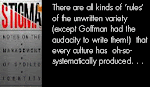
Stigma 1-40
Monday, March 16, 2009


Friday, March 13, 2009
Friday, March 6, 2009
Calendar for Week 8: 3/9, 3/11, 3/13
Due Monday: Ist Informant Presentations 5-7 minutes
Read:
Polite Fictions 62-79
Wednesday: MIDTERM EXAM
Friday: Midterm returned
Read:
Polite Fictions 62-79
Wednesday: MIDTERM EXAM
Friday: Midterm returned
Saturday, February 28, 2009
Peru Group: Tiana, BJ, Whitney C.
1. Turn taking-Do you ever feel like you cannot keep up in a conversation in America?
2. Do Americans tend to interrupt you?
3. What kinds of visual signs/signals do you used to inform individuals and groups of when to start/stop talking or change the subject or anything else?
4. How is turn regulated/How do you know when to talk?
5. Who is allowed to talk to who in order to be socially acceptable?
6. Are there stipulations as to how do address someone or greet someone?
7. When someone talks at the same time as you, is one person assumed to step down?
8. How is this addressed by the rest of the group and how do they perceive it?
2. Do Americans tend to interrupt you?
3. What kinds of visual signs/signals do you used to inform individuals and groups of when to start/stop talking or change the subject or anything else?
4. How is turn regulated/How do you know when to talk?
5. Who is allowed to talk to who in order to be socially acceptable?
6. Are there stipulations as to how do address someone or greet someone?
7. When someone talks at the same time as you, is one person assumed to step down?
8. How is this addressed by the rest of the group and how do they perceive it?
China Group: Martyn, Kimberly, Michael, Melora
1. When listening to someone else speaking, how do you affirm that you are listening to what they are saying?
2. How big of a gap do you leave between speakers before you resume or begin talking?
3. Does your culture have any specific affixes/prefixes or titles (such as for family members) when addressing them? If so, when do you use them and where?
4. Who is it most proper to address first in a group of people (is it based on age, status, family, or whom you are most comfortable with)?
5. When answering a question, do you repeat the question when answering or rephrase the question in your answer?
6. Do you ever ask a question that is really a demand (imperative)?
7. Do you ever switch between polite/formal speech to informal speech in the same conversation?
8. How long does a relationship with someone have to be before you speak informally with them?
9. As you grow older, do you convey more politeness r take on more informal speech when speaking to your parents?
10. How do you respond to someone insulting themselves?
11. What do you say when you enter someone’s home as a guest?
2. How big of a gap do you leave between speakers before you resume or begin talking?
3. Does your culture have any specific affixes/prefixes or titles (such as for family members) when addressing them? If so, when do you use them and where?
4. Who is it most proper to address first in a group of people (is it based on age, status, family, or whom you are most comfortable with)?
5. When answering a question, do you repeat the question when answering or rephrase the question in your answer?
6. Do you ever ask a question that is really a demand (imperative)?
7. Do you ever switch between polite/formal speech to informal speech in the same conversation?
8. How long does a relationship with someone have to be before you speak informally with them?
9. As you grow older, do you convey more politeness r take on more informal speech when speaking to your parents?
10. How do you respond to someone insulting themselves?
11. What do you say when you enter someone’s home as a guest?
Saudia Arabia Group: Sarah P. , Megan S.
1. After inviting someone over, is it polite to serve them or appropriate to allow them to serve themselves?
2. When in the company of guests is it appropriate to be relaxes in manner or have more self-control and remain formal? If neither, what is appropriate?
3. In TV programs, if something is going wrong for the good guys, how would they react?
4. In a work scenario, is it appropriate to joke around? How would people react if people were joking?
5. In a high stress situation, like turbulence on a plane, how would people in your culture respond to humor?
6. How is dependency on others viewed in Saudi Arabia? In times of necessary dependence how is gender and age figured in?
7. When asking for a favor, in what manner of speaking should the request be presented—apologetic, act inferior, just use please/colloquial language? What if you are asking for something from someone you do not know (ie a University scholarship committee)?
8. When explaining things about yourself for applications is it more appropriate to give straight facts or to embellish your accomplishments? If neither, what is appropriate?
9. If something like an animal has a disability, in what way would it be viewed—would someone in your culture take it upon themselves to care for it or would just feel pity and move on?
10. If a friend lost a job and you wanted to comfort them, what would you say? Would you even want to comfort them? Does it depend on age or gender?
11. What would be the most appropriate way to approach someone who is grieving a loss?
12. If you are unable to complete a request for a friend, how does someone in your culture best deny this request?
13. If someone you know is about to take a test (admissions test for college or the like,if you wrote them a card what you it say? What would a parent’s card to a child say in this situation?
2. When in the company of guests is it appropriate to be relaxes in manner or have more self-control and remain formal? If neither, what is appropriate?
3. In TV programs, if something is going wrong for the good guys, how would they react?
4. In a work scenario, is it appropriate to joke around? How would people react if people were joking?
5. In a high stress situation, like turbulence on a plane, how would people in your culture respond to humor?
6. How is dependency on others viewed in Saudi Arabia? In times of necessary dependence how is gender and age figured in?
7. When asking for a favor, in what manner of speaking should the request be presented—apologetic, act inferior, just use please/colloquial language? What if you are asking for something from someone you do not know (ie a University scholarship committee)?
8. When explaining things about yourself for applications is it more appropriate to give straight facts or to embellish your accomplishments? If neither, what is appropriate?
9. If something like an animal has a disability, in what way would it be viewed—would someone in your culture take it upon themselves to care for it or would just feel pity and move on?
10. If a friend lost a job and you wanted to comfort them, what would you say? Would you even want to comfort them? Does it depend on age or gender?
11. What would be the most appropriate way to approach someone who is grieving a loss?
12. If you are unable to complete a request for a friend, how does someone in your culture best deny this request?
13. If someone you know is about to take a test (admissions test for college or the like,if you wrote them a card what you it say? What would a parent’s card to a child say in this situation?
China Group: Allie, Kyle, Susan, Whitney S.
1) Is it appropriate to discuss politics and religion with someone you just met?
2) Is it appropriate to oppose or condemn someone's religious preference?
3) Is it appropriate to talk about success in the workplace and monetary success with someone you just met?
4) What is the appropriate response to a greeting? If someone asks "how are you?" or its equivalent in the Chinese culture, is it appropriate to give a detailed response?
5) Is it considered rude to interrupt someone while they are speaking, or does interruption reflect eager involvement in the conversation?
6) What should be stated directly in conversation? What things should be stated indirectly? Does directness imply imposition?
7) Is it appropriate to accept something the first time it is offered to you?
8) Does a rising or falling intonation in speech reflect a question? How are questions stated?
9) How much information should be provided in order to create a sufficient context for your conversation? How much background is necessary?
10) What is a comfortable level of personal space in conversation? Is this dependent on the relationship between speaker and listener?
11) Is verbal aggressiveness considered threatening, confrontational, engaging, or something entirely different? Is the use of verbal aggressiveness depend on your listener?
12) What assumptions / expectations are associated with conversational overlap? Is overlap associated with imposition or involvement? Is this, too, contingent on the relationship between speaker and listener?
13) How do gender differences affect conversation? Does it affect personal space? Does it affect directness/indirectness? Does age play a factor? Does it affect word choice and intonation?
14) What is the appropriate amount of pause between turns?
15) Is it more appropriate to be aggressive or submissive in your culture? Is this contingent upon the audience?
16) Is it more acceptable to speak more quickly or more slowly in your culture? How is speed of speech perceived?
17) What does insistence and repitition imply in your culture? Is it considered rude and imposing? Does it emphasize what you are trying to say? Is it contingent on the situation?
18) After being asked a question, is it polite or rude to respond with a question? Does responding with a question reflect selflessness and produce a sense that the other person is valued more than yourself? Or does it reflect avoidance and apathy?
2) Is it appropriate to oppose or condemn someone's religious preference?
3) Is it appropriate to talk about success in the workplace and monetary success with someone you just met?
4) What is the appropriate response to a greeting? If someone asks "how are you?" or its equivalent in the Chinese culture, is it appropriate to give a detailed response?
5) Is it considered rude to interrupt someone while they are speaking, or does interruption reflect eager involvement in the conversation?
6) What should be stated directly in conversation? What things should be stated indirectly? Does directness imply imposition?
7) Is it appropriate to accept something the first time it is offered to you?
8) Does a rising or falling intonation in speech reflect a question? How are questions stated?
9) How much information should be provided in order to create a sufficient context for your conversation? How much background is necessary?
10) What is a comfortable level of personal space in conversation? Is this dependent on the relationship between speaker and listener?
11) Is verbal aggressiveness considered threatening, confrontational, engaging, or something entirely different? Is the use of verbal aggressiveness depend on your listener?
12) What assumptions / expectations are associated with conversational overlap? Is overlap associated with imposition or involvement? Is this, too, contingent on the relationship between speaker and listener?
13) How do gender differences affect conversation? Does it affect personal space? Does it affect directness/indirectness? Does age play a factor? Does it affect word choice and intonation?
14) What is the appropriate amount of pause between turns?
15) Is it more appropriate to be aggressive or submissive in your culture? Is this contingent upon the audience?
16) Is it more acceptable to speak more quickly or more slowly in your culture? How is speed of speech perceived?
17) What does insistence and repitition imply in your culture? Is it considered rude and imposing? Does it emphasize what you are trying to say? Is it contingent on the situation?
18) After being asked a question, is it polite or rude to respond with a question? Does responding with a question reflect selflessness and produce a sense that the other person is valued more than yourself? Or does it reflect avoidance and apathy?
Subscribe to:
Posts (Atom)